
Technology guide
How to brief a software development partner: a practical checklist
ZeeSign editorial · 27 November 2026
Define users, workflows, integrations and acceptance criteria before asking for a custom software, website or mobile app proposal.
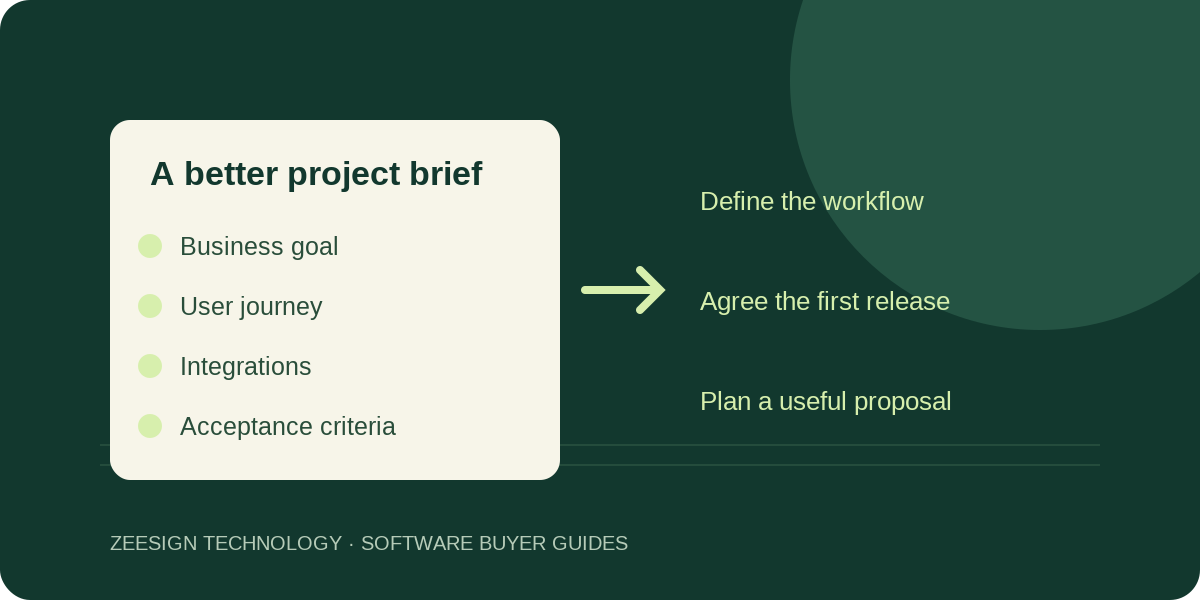
A useful software brief helps a development partner understand the decision you need to make. It does not need to prescribe every screen or choose a framework before the workflow is clear. It should explain who needs the system, what they need to accomplish and how you will recognise a successful first release.
This checklist is for businesses comparing a custom software company, a mobile app team or an ongoing development partner. The examples are illustrative, not client case studies or promises of a particular cost or delivery time.
1. Describe the business problem before the features
Write one short paragraph about the current process. Who performs it, what information they use and where it breaks down? “We need an app” leaves important questions open. “Our storage locations record bookings in separate spreadsheets, so staff cannot reliably see remaining capacity” gives the team a workflow to examine.
Add a baseline if you have one: the time spent reconciling bookings, the number of repeated manual entries or the kinds of customer enquiries your staff receive. Use measured figures only. If you have not measured the problem, say what you want to observe during discovery.
2. Identify the people and their permissions
List the main roles, not just the total number of users. A customer, location employee and operations manager may all interact with the same reservation but need different actions and information. Decide who can create, approve, change, cancel and export records. Mention external partners who need limited access.
For an HR system, describe the distinction between employees viewing their own attendance, managers approving a roster and administrators managing locations. Avoid including real employee or customer records in an initial public enquiry. Discuss an appropriate information-sharing process with the delivery team.
3. Walk through one complete journey
Choose the most valuable journey and describe it from start to finish. For example: a customer selects a storage location and date, sees available capacity, makes a reservation, receives a confirmation, checks in and later collects the item. Then include exceptions: payment failure, capacity changing during checkout, a late arrival or a staff correction.
Exceptions reveal work that a list of screen names misses. A checkout page is only part of a booking system; the business also needs rules for inventory, changes, notifications and staff decisions. Mark the rules you already follow and the ones that still need a decision.
4. Separate the first release from later ideas
Use three groups: essential for the first operational journey, useful after that journey works and optional experiments. Keep a clear reason for each first-release requirement. This helps the team propose a smaller, testable delivery rather than treating every idea as equally urgent.
| Decision | Example first release | Possible later phase |
|---|---|---|
| Booking operations | One capacity rule and staff check-in | Multiple inventory types and partner allocations |
| Reporting | Daily reservation export with agreed fields | Custom dashboards and forecasting |
| Notifications | Booking confirmation and cancellation messages | Additional campaign integrations |
5. Explain integrations and existing assets
Name the systems the product needs to connect to and what data must move in each direction. Include payment providers, accounting systems, existing websites and internal databases when relevant. State whether documentation, a test environment and an authorised account contact are available. Do not send passwords or private keys in a contact form.
List assets you already own: source code, a design file, brand artwork, domain access, written content or a functioning prototype. Clarify who controls each account and whether a previous supplier must help with a handover. These details affect scope and dependencies, so they should be discussed before agreeing a delivery commitment.
6. Describe platform needs without guessing the stack
Say where people will use the product: an office browser, an Android device at a storage desk, an iPhone on a customer journey or a desktop workstation. Mention connection reliability, camera or location features, accessibility needs and languages. Explain any existing technology constraint and its reason.
A WordPress website may suit a content-led company site, while a custom application may suit a role-based operational workflow. A mobile project may need native capabilities or may suit a cross-platform approach. Ask the team to explain the trade-offs against your requirements. A longer technology list is not a substitute for a delivery plan.
7. Define acceptance and ownership
Describe observable outcomes. Instead of “the report should work,” specify who exports it, the date range, required columns and a small example of the expected result. Agree how changes, defects and release approval will be handled. Ask what the proposal includes for testing, deployment and support.
Also ask about source-code handover, account ownership, documentation, backups and ongoing maintenance. Clarify what happens after launch and which responsibilities remain with your business. These should become explicit proposal terms rather than assumptions.
8. Choose a project team or an ongoing developer engagement
A defined project usually needs agreed deliverables and acceptance criteria. An ongoing developer engagement also needs working-time overlap, allocation, backlog ownership and a process for prioritising work. If an agency is seeking delivery support, explain how client communication, review and handover should operate. Availability and commercial terms need confirmation.
A brief you can copy into your enquiry
- Business goal: What should improve, and for whom?
- Current process: How is the work done today?
- User roles: Who views, edits and approves information?
- Core journey: What happens from start to finish?
- First-release essentials: Which outcomes cannot wait?
- Integrations and assets: What exists and who controls it?
- Platforms and languages: Where will people use the product?
- Acceptance: How will you check that it works?
- Timing and engagement: What dates, dependencies and team arrangements should be discussed?
You can leave unknowns open. The purpose of discovery is to resolve them together, not to expect a complete technical specification in the first message.
Discuss your next step with ZeeSign
Explore web and WordPress development, Android and iOS development, business software or dedicated developer support. For the booking example, see our luggage storage and booking systems service. German-language buyers can begin at Entwickler beauftragen.
Editorial note: this guide was prepared with AI assistance and checked for scope and consistency with ZeeSign’s service information. Examples are illustrative. Confirm project-specific requirements with the delivery team.